Preamble:
Paolo Giorza (1832 - 1914) was born in Milan and died in Seattle. Giorza started his career early reportedly writing a mass at age nine. His first steps in ballet music came at age thirteen when he added music to Cesare Pugni's La Fille du Bandit in accordance with Francesco Penco who was reproducing and revising Perrot's choreography for the Teatro Comuale in Bologna. He seems to have been influenced early on by the choreographer, Giuseppe Rota. Antonio Ghislanzoni, a friend of Rota's, would write this of the relationship between the composer and choreographer "Paolo Giorza is a creation of Rota. The young maestro was inflamed by the intoxicating words of the young choreographer. They spent the nights together. He declaimed his concepts, evoking the ghosts of his genius in the deserted room.—And ideal sylphs danced around the piano, inspiring a young composer of harmony, a music full of movement and flashes" (translated from Italian). It was for Rota that Giorza would help score many ballets (at least in part) including Un Fallo, Cleopatra, Il Giocatore, and Il Conte di Montecristo. He was prolific in the realm of ballet music. His career started assisting Giuseppe Rota but his skills would also be used by Pasquale Borri, Federico Fusco, and Giovanni Casati just to name a few. Giorza was a patriot and among other nationalistic pieces, composed the famous song-polka, Daghela Avanti un Passo. Giorza was knighted by Victor Emmanuel II. Whilst he was not composing ballets he kept himself busy with composing ballroom music for the entertainment of many who would play it at home on their pianos. Giorza tried opera at least twice. One of them, Corrado il Console di Milano, was a failure. Giorza left Italy in 1867 for America where he would write music for the Can-can dance which was recently imported to the States by his friend Giuseppina Morlacchi. He would end up in Australia in 1871. He would be an important figure in the importation of European (and especially Italian) music there. Among other notable achievements, he directed the Australian premiere of Verdi's requiem. In 1883 he left Australia and returned to Italy. Shortly after his return, he scored Rodope - his last ballet - for Raffaele Grassi. He left Italy for the last time to return to the United States again. He lost a considerable amount of his wealth and possessions in the 1906 San Francisco earthquake. He died in 1914, impoverished, in Seattle.
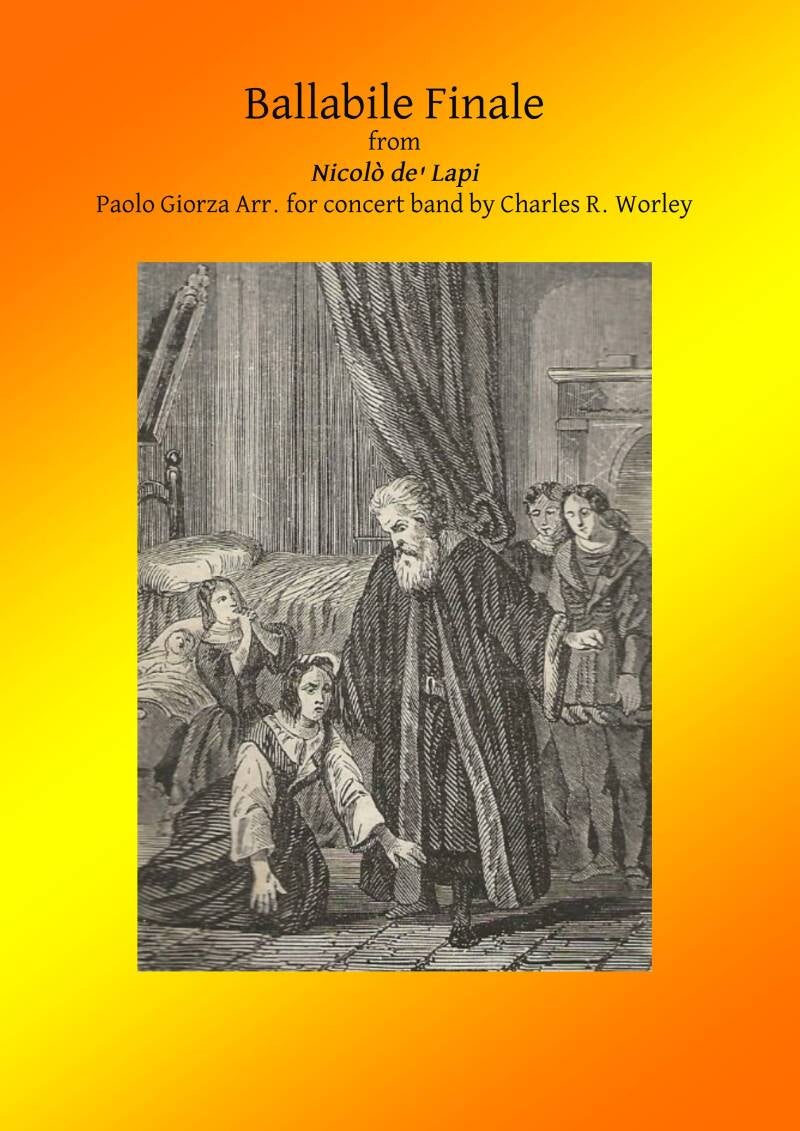
Nicolò de' Lapi (also written as Niccolò de' Lapi), ballo storico in sei atti was choreographed by Federico Fusco and premiered at the Teatro Apollo, Rome, during the carnival season of 1858. The plot was most likely inspired by Massimo d'Azeglio's novel, Niccolò de' Lapi, ovvero i Palleschi e i Piagnoni. The music was subsequently reduced for piano and published by F. Lucca in milan, the publisher of most of Giorza's oeuvre.The selection presented here in the Ballabile Finale (subtitled Gran Gallopp) which concludes the entire ballet.It was common for 19th-century Italian ballets in end in a Galop Ballabile. Like most ballets of 19th-century Italy, the opus remains in oblivion today; thus the present arrangement constitutes the only modern performance edition of this piece whether in whole or part.
Instrumentation:
Piccolo
Flute I, II
Oboe I, II
Basson I, II
E♭ Clarinet
B♭ Clarinet I, II, III
B♭ Bass Clarinet
E♭ Alto Saxophone I, II
B♭ Tenor Saxophone
E♭ Baritone Saxophone
F Horn I, II, III, IV
B♭ Trumpet I, II, III
Baritone
Trombone I, II, III
Tuba
Percussion I, II
(I contains Cymbals and Bass drum)
(II contains Snare drum and triangle)